

Cost is usually the first question we get once someone has decided a bioclimatic pergola actually fits their outdoor space. It’s a fair question, because the price range across this category is wide, running from a few thousand euros for a compact standard model to well beyond that for a large, fully automated system, and a single number rarely tells the full story.
We work on the design and engineering side of this category at Light Hunter, so rather than quote one figure, we’d rather walk through what actually drives bioclimatic pergola cost, how that compares with a solar pergola that adds energy generation on top, and where the real trade-offs sit.
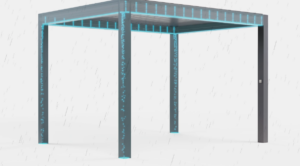
What Determines a Bioclimatic Pergola’s Price
A bioclimatic pergola is, at a basic level, an aluminum structure with adjustable louvers that open and close to manage sunlight, airflow, and rain. That description covers a huge range of products, though, and several factors push the price up or down within it.
Size is the most obvious one: more square meters means more aluminum, more louvers, and a larger motor and control system. Automation level matters almost as much. A manually operated pergola costs less than a motorized one, but most buyers choose motorized systems anyway, so the real cost differences tend to show up in the extras layered on top, such as rain and wind sensors that close the louvers automatically, app-based control, or integration with a broader smart home system.
Enclosures add cost as well. A basic open-sided structure is cheaper than one with glazed or screened sides, and reinforced louver profiles are typically needed on wider spans or in regions with heavier snow loads, which adds engineering cost on top of materials. Site conditions play a role too: a straightforward ground-level patio installation is generally more affordable to build than a project involving uneven terrain, a raised terrace, or complicated drainage routing.
Ongoing costs matter as well, even if they’re smaller: motorized louvered systems generally need periodic mechanical servicing to keep everything operating smoothly, and that maintenance budget is worth factoring in alongside the upfront structure cost, not treated as an afterthought.
General Price Ranges Homeowners Report
Because so many variables are involved, published pricing tends to come as a range rather than a fixed figure, and that range varies a fair amount by region. Published prices vary significantly by region, size, materials, automation level, installation requirements, and additional features, so a general range should only be treated as an initial budgeting reference.
In markets like the UK and US, broader pergola pricing guides place bioclimatic and fully motorized louvered systems toward the upper end of the overall pergola market, often running into the tens of thousands for larger, highly automated installations. None of these figures should be treated as a quote for a specific project. They’re a useful starting point for budgeting, not a substitute for a site-specific estimate.
Solar Pergolas: Why Energy Generation Changes the Cost Conversation
A solar pergola adds another layer to this pricing picture, because it isn’t just a shading structure with a motor, it’s a shading structure with a photovoltaic system built into the roof. That means the cost conversation includes components a standard bioclimatic pergola doesn’t have: solar modules integrated into the louvers, an inverter, wiring, and in many cases a connection point for home battery storage.
Those additions raise the upfront cost compared with a non-solar bioclimatic pergola of the same size, but they also change what the structure is doing for you over time. Instead of only providing shade and weather protection, it’s generating electricity that can offset part of a household’s energy use, which is worth factoring into any cost comparison rather than looking at the sticker price alone.
Our own Energy Pergola works this way. The louvered roof runs on perovskite photovoltaic technology and produces between 780W and 960W depending on the size selected, on top of the shading, airflow, and weather-response features a bioclimatic pergola is expected to deliver.
The comparison should therefore consider both the additional photovoltaic components and the different functions provided by the integrated structure, rather than comparing the base structure alone.
Getting an Accurate Quote for Your Project
Because size, region, automation level, and whether solar generation is included all move the price, we don’t publish a single fixed number for our solar pergola, and we’d be cautious of any bioclimatic pergola supplier who does without first understanding your site. What actually affects your quote is fairly specific: the dimensions you need, your local wind and snow load requirements, whether you want side screens or additional lighting, and whether you’re connecting the system to existing home battery storage.
At Light Hunter, we work through a growing dealer network across Europe, and we’d rather walk through those details with you directly than guess at a number that may not reflect your actual site conditions.
If you’re weighing a bioclimatic pergola against other outdoor upgrades, or you already have a rough sense of the size and features you want, Contact Us and we can help put together a more accurate picture of what your project would involve.