

There is no reliable single price for a motorized louvered pergola because cost varies by size, materials, automation, site conditions, installation, and local requirements.
Below, we’ve broken down what actually drives the price of a motorized pergola system, what kind of ranges tend to show up across the industry, and a few additional costs that are easy to overlook when budgeting for a project.
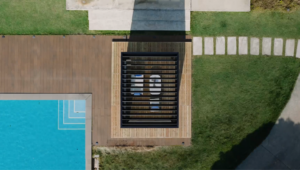
What Drives the Price of a Motorized Pergola
Several factors combine to determine what a motorized louvered pergola ends up costing, and size is usually the most obvious one. A small patio cover and a large multi-section structure covering an outdoor dining and lounge area aren’t priced the same way, and the cost per square foot tends to shift somewhat as the overall footprint grows, since certain fixed costs — like the motor system and control components — don’t scale directly with size.
Material choice plays a role as well. Aluminum framing is common in motorized systems because it holds up well outdoors and pairs easily with automated louvers, though the specific alloy, finish, and engineering behind the frame can vary meaningfully between manufacturers.
Beyond the frame itself, the motor and automation package — whether it’s a simple remote-controlled system or one that includes weather sensors, app control, and smart home integration — adds its own layer of cost on top of the base structure.
Site conditions and installation complexity round out the picture. A pergola installed on an existing, level patio with straightforward electrical access is generally less involved than one requiring new footings, additional electrical work, or engineering for wind and snow loads specific to a region. Permitting requirements also vary by location, which can affect both the timeline and the total project cost.
Typical Price Ranges in the Market
For a fairly common residential size, several sources put the all-in installed cost somewhere in the $7,900 to $18,000 range for a mid-size motorized system with basic remote control, before factoring in higher-end finishes or extensive automation.
These figures move quite a bit based on the factors described above, and we’d treat any published range as a starting point for budgeting conversations rather than a fixed number for a specific project. Larger, fully custom installations with premium motors, integrated lighting, and drainage systems can run well beyond these ranges, sometimes into the tens of thousands of dollars for larger footprints.
Where a Solar Pergola Fits Into the Cost Conversation
One variation worth understanding separately is a solar pergola — a motorized or fixed pergola structure with a solar panel roof rather than louvered aluminum blades. Because a solar pergola combines a shading structure with a power-generating roof, its cost structure includes the panels, inverter, and related electrical work on top of the base frame, which typically puts it in a different pricing category than a standard louvered system.
At Light Hunter, our solar pergola is built around this combined approach — providing shade for a patio, driveway, or outdoor living space while the roof also contributes to the property’s electricity supply. Because pricing depends on the size of the structure, the electrical setup already in place, and any regional permitting requirements, we don’t publish a single flat rate; a project-specific quote gives a more accurate picture than a general range would. It offers a different value proposition from a purely shading-focused system because it combines outdoor comfort with on-site electricity generation.
Additional Costs to Plan For
Beyond the structure and installation itself, a few other costs tend to come up during a motorized pergola project. Electrical work — running power to the motor and, for solar systems, connecting the panels to the property’s electrical panel — is often a separate line item from the structure’s base price, particularly if existing wiring doesn’t reach the installation site. Permitting fees vary by municipality and can add both cost and time to a project timeline, especially for larger or more visible structures.
Ongoing costs are typically modest but worth factoring in. Motorized systems may benefit from occasional inspection or maintenance, particularly for the motor and any moving parts, and some finishes may need periodic touch-up depending on climate exposure. These costs are generally smaller than the upfront installation but can add up over the life of the structure.
Getting an Accurate Number for Your Project
General price ranges are useful for early budgeting, but the number that actually matters is the one specific to a given property — its size, site conditions, electrical setup, and the features being considered. Rather than trying to fit a project into a published national average, we’d suggest treating those figures as a rough starting point and getting a quote based on the actual site.
If you’re comparing a standard motorized louvered pergola against a solar pergola for your property, or just trying to understand what a realistic budget looks like for your space, Contact Us and we can walk through the specifics with you.