

We get asked fairly often where a product like ours actually fits between passive design and active design, since it doesn’t cleanly belong to either category on its own. It’s a fair question, and it’s worth answering directly rather than assuming everyone already has the distinction straight, because active design vs passive design isn’t just an academic split, it affects how comfortable an outdoor space feels and how much energy it needs to stay that way.
What Active Design Actually Means
Active design generally relies on mechanical, electrical, or powered systems to control environmental conditions such as heating, cooling, ventilation, lighting, or shading.
Heating and cooling equipment is the most obvious example, forced-air HVAC, heat pumps, radiant panels, but electric lighting, mechanical ventilation, and motorized shading controls all count too, since they rely on power to function. Somewhat counterintuitively, solar panels and other renewable generation systems are also classified as active design, even though they’re often framed as the “green” choice.
The reasoning is straightforward: an active system is one that converts or uses electricity to do its job, whether that job is cooling a room or generating power in the first place. Buildings account for roughly 30% of global final energy consumption according to International Energy Agency estimates, which is part of why active systems, and how efficiently they’re specified and used, matter so much to overall energy performance.
Active strategies also tend to be easier to retrofit than passive ones, since installing a heat pump or a set of solar panels on an existing structure is generally more straightforward than reworking a building’s orientation or envelope after the fact.
Where Passive Design Still Does the Heavy Lifting
Passive design, in contrast, relies on unpowered elements, orientation, thermal mass, insulation, natural ventilation, and fixed or adjustable shading, to manage comfort without drawing on electricity. In an outdoor setting specifically, that typically means things like a fixed overhang sized to block summer sun, deciduous trees planted for seasonal shade, or a patio positioned to catch prevailing breezes.
None of that requires power to work, which is exactly the appeal: passive strategies keep working during a power outage, don’t add to a utility bill, and generally need less maintenance than equipment with motors or electronics. Most well-designed outdoor spaces still lean on passive measures as the starting point, since no amount of active equipment fully compensates for a space that’s badly oriented or unshaded to begin with.
This is also why architects and engineers who work across both categories tend to treat passive design as the foundation and active systems as the layer added to cover whatever gap remains, rather than the other way around.
How Solar Pergolas Blend Active and Passive Design
This is where our own product doesn’t fit neatly into either category, and that’s largely the point. A bioclimatic pergola already sits in a slightly hybrid space: the structure and louver form are passive in the sense that they manage sun and rain through positioning and geometry, but the motors that open and close those louvers are an active system layered on top.
A solar pergola adds a second, more significant active layer by generating electricity from the same roof surface.
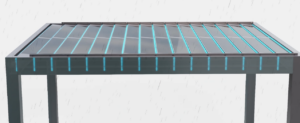
Our own Energy Pergola works exactly this way. The louvered roof runs on perovskite photovoltaic technology, generating power directly from the same structure that’s providing shade, while a weather-responsive automation system adjusts the louvers as conditions change, closing them ahead of rain or high wind without someone needing to notice and intervene.
In some configurations, the pergola connects to home battery storage, so power generated during the day can be used later. It’s a genuine example of active and passive design working through the same physical structure rather than as two separate systems bolted together, which is different from, say, adding solar panels to an existing fixed patio roof after the fact.
What This Means for Outdoor Comfort and Energy Use
The practical difference shows up in day-to-day use more than in any single spec. A fixed pergola only shades where it’s positioned to shade, and it doesn’t respond if weather shifts partway through the afternoon.
A solar pergola’s automated louvers can close in response to an approaching storm or open again once conditions clear, which reduces how often someone needs to manually adjust screens, move furniture indoors, or run a separate active system like an outdoor heater or fan to compensate for a space that isn’t responding to conditions on its own.
The on-site generation adds a second efficiency angle: instead of drawing entirely from the grid to power outdoor lighting, USB-C charging points, or connected storage, some of that demand is offset by the structure itself. Neither of these benefits eliminates the need for good passive fundamentals in the first place, like reasonable orientation and appropriate sizing for the space, but they do reduce how much a household needs to think about the space once it’s built.
Where Light Hunter Fits In
We built our solar pergola specifically around this overlap between active and passive design, rather than treating shading and generation as separate product categories. Light Hunter‘s Energy Pergola combines a passive shading structure, automated active controls, and on-site power generation in one system, engineered for outdoor use with aluminum construction and weather-rated performance.
We think that combination is a reasonable direction for outdoor structures generally, even if it isn’t the only way to approach the active-passive balance in a given project.
If you’re weighing how active and passive design considerations apply to your own outdoor space, Contact Us and we can walk through what would work for your specific site.